
Myanmar’s golden capital city reminds the visitors of the old time gone. You can walk in the shade of the charming colonial buildings, in the joyful confusion of market stalls, in the glittering pagodas and temples to plunge, slowly, into the Burmese charming atmosphere.
Everyday from dawn to sunset hundreds of people come to pray and walk around the golden glittering stupa, Shwedagon Pagoda, the landmark of Yangon, described in the 20’s by S. Maugham as “a sudden hope in the darkness of soul”.
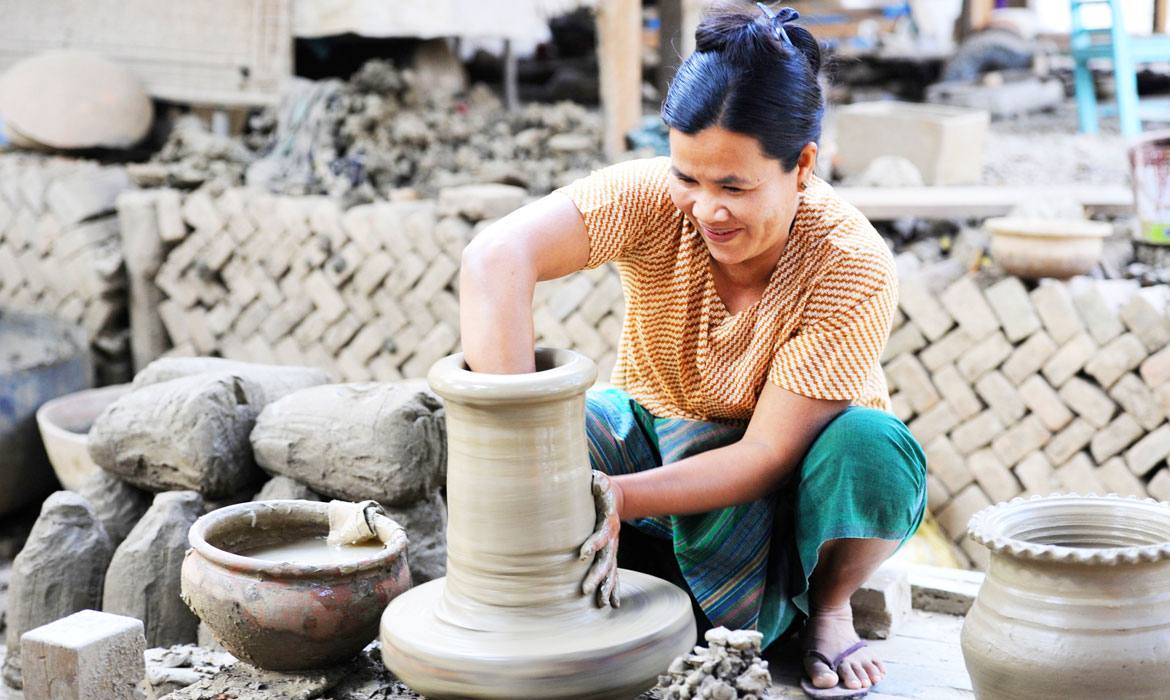
Last capital of the Burmese kingdom, Mandalay is the second largest city of Myanmar and is situated in the hot and dry central dry region of the country. This most important cultural centre is surrounded by other ancient royal capitals- Sagaing, Ava (Inwa) and Amarapura which are also very interesting destinations according to their long lasting historical and religious importance mile stones. In Mandalay visitors can watch traditional handicrafts being made, such as silk and cotton weaving, bronze forges, marble and wood carving. Mandalay also houses the most revered Buddha statue in the whole of Myanmar, the Maha Myat Muni. Another interesting point is the 230meter high Mandalay Hill, from where one has a scenic view of Mandalay and surroundings, the most beautiful in the time of sunset.
Over 2.000 temples and pagodas spread in an area of 40 square km make Bagan one of the most important and remarkable archaeological site of all Asia. A tranquil and mystical atmosphere surrounds the hundreds of golden, white and reddish buildings offering the visitors a unique and memorable experience.
Inle lake is roughly 20km long and of outstanding beauty within its natural surroundings. The area is inhabited by the Intha people living on floating villages and houses on stilts, famous for their unique leg-rowing technique and for growing a wide variety of products on floating gardens. Not to be missed are the colourful Shan State community markets held on a traditional rotating basis according to the Buddhist Sabathdays.
In the surroundings there is Kalaw, a former colonial hill station, on the western edge of the Shan plateau and the Pindaya Caves where there are 8.094 Buddha images.
The story tells the beach was named after an Italian, who lived here for a while, reminded him the coastline of Naples. Most probably it comes from the pronunciation of its Burmese name that means some like “Inveigling Fish”.
The beach is located in the state of Rakhine or Rakhaing (Arakan in Bengalese) in Western Myanmar facing the Bay of Bengal. Thandwe (Sandoway during British colonial period) is about 25 minutes drive and the airport about 15 minutes.
Ngapali is a 3 km long white sandy and unspoilt beach overlooking the clear blue-water of Bay of Bengal, backed by swaying coconut palm and casuarinas trees. After sunset the sea in front of the beach is enlightened by the several lamps of the fishermen boats until morning. Before dawn on the shore other fishermen begin setting and drawing drift nets until late morning when they load their catches in baskets.
The surroundings are plenty of small villages that you can reach by bicycle or by walking along the beach. Thandwe, the most important town of the area, has an interesting market set in a former British jail where traditional medicine herbs, clothes, textile, hardware and food are sold.
Mrauk-U
Once the capital of the powerful Rakhine kingdom and an important free trade port in the 16th century, Mrauk-U is now an archaeological site with several interesting temples and buildings. The most important temple is the massive Shittaung (the shrine of 80.000 images) built in 1535 by King Minbin and its interior walls are engraved with over 1.000 Buddhist figures. Additional interesting sightseeing points are the ruins of the royal palace and the remains of the city walls.
Sittwe (Akyab)
Sittwe (known as Akyab), with atleast a 2000 year history of habitation, sits at the mouth of the Kaladan River where it empties into the Bay of Bengal. It can be reached by air, approximately one hour flight, from Yangon. Sittwe boasts several interesting pagodas and a very exceptional monastery that has a wonderful collection of Buddha images, some dating back to the 15th century. Sittwe's main importance lies in the fact that it is the gateway to the archaeological site of Mrauk U with the historical temples of the 15th and 16th centuries.
Mogok
It is told that in the 6th century, the Italian merchant Ludovico de Varthema, purchased 200 rubies (paid with some coral) after seeing the gems shining at moonlight. This tale attracted hordes of unscrupulous traders looking for sapphires, rubies and other precious stones. Set in an upland valley at over 1.000 mt, the town is located around a beautiful lake. With prior arrangement, required special permit can be applied for tourists to visit Mogok.